The value of the expressions 4/(3*(2-1)) and 4/3*(2-1) is the same.
a) True
b) False
Explanation: Although the presence of parenthesis does affect the order of precedence, in the case shown above, it is not making a difference. The result of both of these expressions is 1.333333333. Hence the statement is true.
What will be the value of the following Python expression?
a) 4
b) 7
c) 2
d) 0

Explanation: The order of precedence is: %, +. Hence the expression above, on simplification results in 4 + 3 = 7. Hence the result is 7.
Evaluate the expression given below if A = 16 and B = 15.
a) 0.0
b) 0
c) 1.0
d) 1

Explanation: The above expression is evaluated as 16%15//16, which is equal to 1//16, which results in 0.
Which of the following operators has its associativity from right to left?
a) +
b) //
c) %
d) **
Explanation: All of the operators shown above have associativity from left to right, except exponentiation operator (**) which has its associativity from right to left.
What will be the value of x in the following Python expression?
a) 43
b) 44
c) 22
d) 23
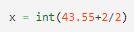
Explanation: The expression shown above is an example of explicit conversion. It is evaluated as int(43.55+1) = int(44.55) = 44. Hence the result of this expression is 44.
What is the value of the following expression?
a) (6.0, 16.0)
b) (6.00, 16.00)
c) (6, 16)
d) (6.00, 16.0)

Explanation: The result of the expression shown above is (6.0, 16.0). This is because the result is automatically rounded off to one decimal place.